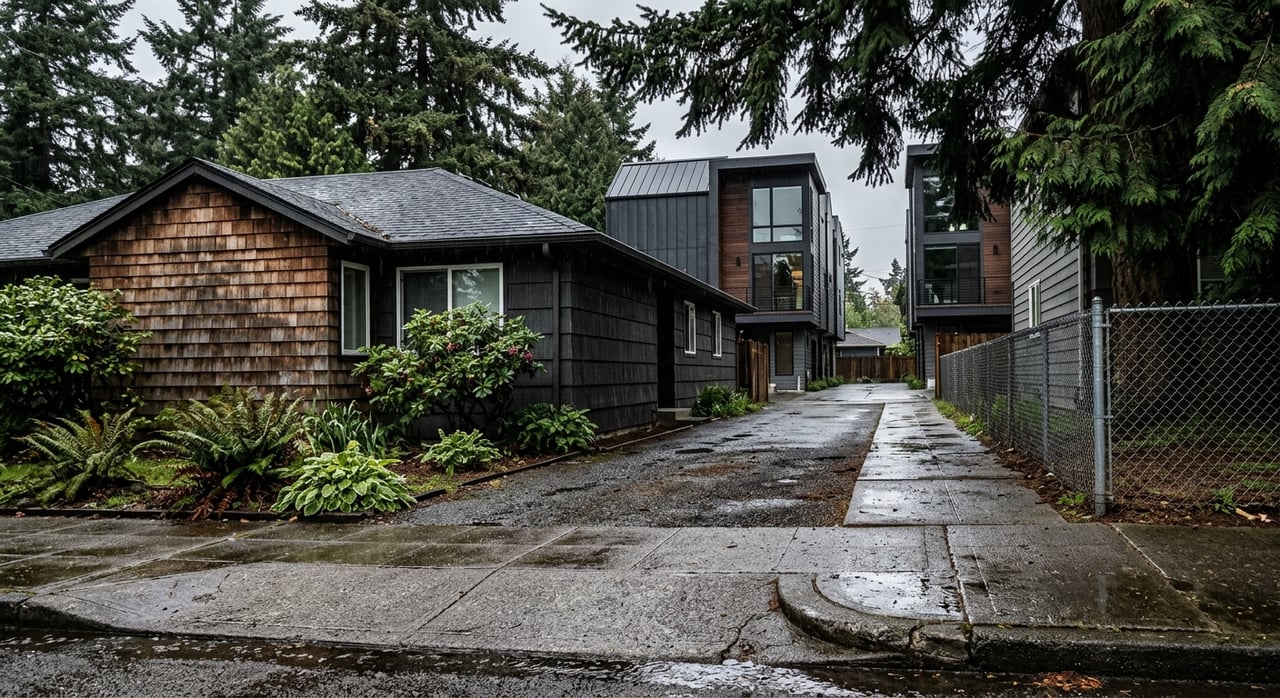
Spotting Infill Development Sites In Bothell
May 7, 2026
May 7, 2026
If you are looking for an infill development site in Bothell, the biggest risk is often not finding land. It is misreading what a parcel can realistically support. In a city with strong housing demand, evolving zoning rules, and site-specific constraints, the best opportunities usually come from careful screening, not quick assumptions. This guide will help you spot the Bothell parcels that deserve a closer look and avoid the ones that can drain time and capital. Let’s dive in.
Bothell offers a useful mix of demand, policy support, and redevelopment potential. The city estimated its population at 49,550 in April 2023, with 20,824 physical housing units, and it has an adopted target of 12,782 new units from 2020 through 2044. At the same time, citywide land use is still dominated by low-density residential patterns, which keeps infill and attached-housing opportunities in the conversation.
Market signals also matter when you are underwriting a site. Redfin’s current Bothell market pages show a median home sale price of $970,000 and about 9 days on market across all home types. Its townhouse page shows 12 active townhouse listings at a median listing price of $862,000, which suggests continued resale demand for attached product even with relatively limited inventory.
Your first screen should be simple: does the parcel sit in a place where the city is already directing more housing? Bothell approved the final 2024 Imagine Bothell Comprehensive Plan Periodic Update and associated development regulations on December 10, 2024. That plan guides where new residential units, transportation improvements, and capital investments such as utilities, sidewalks, and parks are expected to go.
That matters because infill sites usually perform best when they align with the city’s long-term growth map. Planning materials repeatedly point to central Bothell, west of Downtown, west of Midtown, Downtown, Canyon Park, North Creek, and Midtown as areas where added density, reduced lot sizes, and higher heights or floor area ratios are intended to help accommodate more housing. When a parcel falls within those growth-focused contexts, it may deserve faster attention.
Bothell’s middle housing rules are one of the most important recent policy shifts. Ordinance 2407, effective December 13, 2023, amended the comprehensive plan to allow middle housing in all residential zones. The city describes middle housing as duplexes, triplexes, fourplexes, cottage housing, and accessory dwelling units, while townhomes are separately defined as side-by-side attached units with individual entrances.
For site hunters, that means the opportunity set is broader than it used to be. A parcel that once looked too small or too conventional for a traditional townhouse play may still support a middle-housing concept. You still need to confirm the specific development standards, but the policy direction is clear.
Bothell’s map and GIS pages should be part of every early screen. The city provides zoning, land-use designations, city and county boundaries, sewer and water district maps, wetlands and streams, landslide-prone deposits, liquefaction-prone deposits, and other layers that can flag entitlement risk before you write an offer.
There is one important caution here. Bothell states that these maps are produced for internal purposes and carry no guarantee of accuracy. In practice, that means the maps are a starting point, not a substitute for survey, title work, and deeper diligence.
A common mistake is assuming the largest parcel is the best infill site. In Bothell, that can be the wrong conclusion. The more useful question is whether the lot has clean buildable area, workable access, and utility conditions that support your intended product.
Recent city examples reinforce that point. Some smaller sites have moved forward with attached or middle-housing concepts, while other parcels with more land on paper were heavily limited by wetlands, streams, buffers, or access challenges. In other words, yield starts with usable land, not gross square footage.
Critical areas can make or break a Bothell site. The city’s GIS data and recent project files show recurring issues with wetlands, streams, floodplain conditions, slopes, landslide-prone areas, and liquefaction-prone areas. These factors can shrink the net buildable footprint, trigger mitigation, or change the entire site plan.
The 214th Townhomes example shows why this matters. That parcel had only 435 square feet of net buildable area because wetlands, streams, and buffers consumed most of the lot, and the project relied on a shared 20-foot driveway and a reasonable-use permit path. A site may be developable in theory and still be highly constrained in practice.
Access is one of the most overlooked parts of infill screening. Before you get too far, verify frontage, internal circulation, driveway concepts, and whether the parcel may require private access tracts, public access easements, or turnaround solutions.
The 191st Street 24 Townhomes project is a good example. The city approved the downtown project with conditions that included a hammerhead turnaround on a private dead-end street longer than 250 feet, along with full frontage improvements. Those requirements can affect layout, cost, and unit count, so they belong in your first-pass underwriting.
A parcel can look attractive until utility and stormwater obligations come into focus. Bothell’s standards cover grading, streets, storm drainage, water distribution, sanitary sewers, traffic control, and fire prevention. The city has also adopted the 2021 King County Surface Water Design Manual, as amended in 2024, which reinforces the need to evaluate drainage and offsite requirements early.
The practical takeaway is simple: confirm water, sanitary sewer, and storm drainage availability before you get attached to the deal. You should also consider whether offsite pipe replacement, water-main looping, or other utility upgrades may be needed. In Bothell, offsite obligations are often a major part of underwriting.
One of the best ways to spot opportunity is to compare a candidate site with projects the city is already processing. Bothell’s public land-use notices show a live pipeline that includes 191st Street 24 Townhomes, 214th Townhomes, the Elkington Smile townhome projects, and Medina 6-Lot Short Plat. Together, they show the range of forms the city is seeing right now.
These examples do not guarantee that another parcel will follow the same path. Still, they are useful signals for what kinds of sites are proving workable under current conditions.
The 191st Street project redeveloped a 47,842-square-foot vacant site in the General Downtown Corridor District into 24 attached townhomes. Even with slopes and wetlands on site, the project advanced with conditions tied to access, utility looping, frontage work, and connections to public utilities.
That tells you something important about downtown and central-area parcels. Even when the site is imperfect, a growth-oriented location with utility access and a supportable attached-housing concept may still pencil better than a larger parcel in a less favorable context.
Elkington Smile shows how suburban-edge sites can come together for attached housing. Division One approved 18 attached townhomes and Division Two approved 21 attached townhomes along Bothell-Everett Highway. The projects shared utility, street, and stormwater improvements, used private internal streets and driveways, and sat in a mix of R-AC, OP, and CB zoning.
This kind of example can help you spot assembly potential. If adjacent parcels share a corridor location, utility logic, and zoning context that supports attached product, the combined site may be more useful than either lot alone.
Medina 6-Lot Short Plat is a strong reminder that smaller infill sites can still be compelling. A 45,220-square-foot parcel was proposed for subdivision into six residential lots, with two townhome units on each lot, access through a private tract from NE 152nd Place, on-site detention, and no critical areas on or adjacent to the site.
That is often the profile worth chasing. A smaller parcel with manageable access, no major environmental encumbrances, and a straightforward drainage path can outperform a more dramatic site with hidden constraints.
When you are screening infill opportunities in Bothell, use a checklist that moves from broad fit to parcel-level risk.
Start by confirming the parcel on the city’s zoning and land-use designation maps. Then cross-check GIS layers for parcel shape, subarea context, roadway classification, and obvious environmental constraints.
Bothell’s May 2025 Planning Commission code table for residential development standards lists zones including R-C, R-L1, R-L2, R-M1 through R-M4, and R-AC combinations. The table shows base density rising as high as 80 units per acre in R-M4, along with different lot-area, setback, height, and coverage standards by zone.
This is where rough yield assumptions start to become more realistic. You are not trying to finalize unit count yet. You are trying to understand whether the zone and standards support the product type you have in mind.
Check for wetlands, streams, slopes, floodplain conditions, landslide-prone areas, and liquefaction-prone deposits as early as possible. If these layers cover too much of the site, your practical yield may drop fast.
Look at street frontage, driveway feasibility, internal circulation, and any signs that frontage improvements or special access solutions may be needed. In many infill deals, this is where the first real cost surprise shows up.
Review water, sewer, and stormwater service availability and think through likely offsite work. Utility frontage and connection feasibility can separate a viable parcel from a frustrating one.
Compare the parcel with recent Bothell examples. Some sites fit 3-unit townhouses on constrained lots. Others support short plats with multiple attached units, and larger properties can support 18- to 24-townhome concepts. The right question is not just “how many units?” but “what type of project fits the site cleanly?”
Based on Bothell’s current plan framework and recent approvals, the strongest infill candidates are usually not simply the biggest parcels or the cheapest ones per square foot. They are the parcels with manageable access, defensible utility frontage, limited critical-area encumbrance, and a zoning or subarea context that already supports attached or middle housing.
That is where disciplined screening creates an edge. If you can identify parcels that match the city’s growth direction and avoid obvious buildability traps, you put yourself in a better position to move with confidence.
Whether you are evaluating a single infill lot, a townhouse site, or a small assembly, a strategic first-pass review can save months of effort. If you want help pressure-testing Bothell opportunities, Foundation First Group brings development-minded market insight, acquisition strategy, and hands-on advisory support to help you focus on the sites with the best real potential.
Stay up to date on the latest real estate trends.
Foundation First Group's expertise includes assisting buyers and sellers of all property types, including single-family homes, condominiums, vacant land, and investment properties.