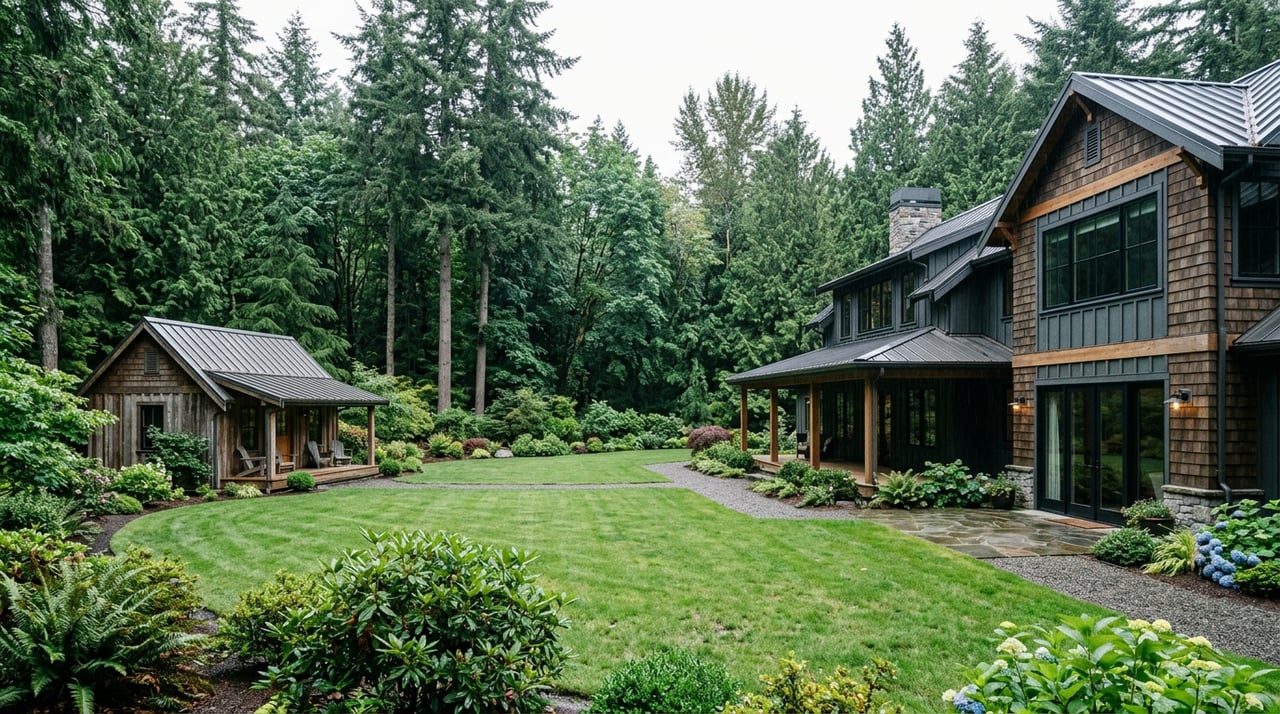
Buying Snohomish Acreage for ADU & Cottage Homes
April 23, 2026
April 23, 2026
Buying acreage in Snohomish for an ADU or cottage-home project can look simple on paper, but the details matter fast. A parcel that seems perfect online may have zoning limits, septic constraints, or critical-area setbacks that change what you can actually build. If you want to buy smart, this guide will help you understand what to verify before you make an offer and where the biggest opportunities, and risks, usually show up. Let’s dive in.
Before you evaluate any acreage, confirm whether the property sits in unincorporated Snohomish County or inside the City of Snohomish. That distinction matters because county development rules apply only to unincorporated land, while city parcels follow the city’s own land-use code.
According to Snohomish County materials, the City of Snohomish adopted ADU regulations in September 2024 and was revising them in 2026 to align with Washington condominium law. That means city parcels should be checked against current municipal rules, not county bulletins. For county parcels, the county’s development guidance and code will be the framework you use for feasibility.
One of the most important acreage due-diligence items is legal lot status. Snohomish County states that lot status should be verified before or at the time of a building permit application, and parcels without recognized legal lot status may be rejected or sent back for a formal determination.
In practical terms, you do not want to assume a parcel is buildable just because it has acreage or appears in the MLS. If you are buying for an ADU, cottage housing, or a small multi-home concept, legal lot status should be one of the first checks in your review process.
If the parcel is in unincorporated Snohomish County, your next step is understanding the difference between an ADU opportunity and a small development opportunity. These are not the same thing, and they follow different code paths.
For many buyers, the right strategy comes down to whether you want one extra unit with a primary home, or a more formal multi-home layout that may require subdivision-style planning.
Snohomish County defines an ADU as a dwelling unit on the same lot as the principal unit. Under current county code, urban zones can allow up to two ADUs on lots with a single-family, single-family attached, or duplex dwelling, while rural, resource, and other zones generally allow one ADU on a lot with a legally established single-family dwelling.
The code also limits ADU floor area to 1,200 square feet and requires documentation showing water supply and septic capacity. In rural and resource areas, ADUs must use the same driveway as the primary dwelling. Detached ADUs are also restricted on smaller lots in certain zones, including R-5 lots under 5 acres and RC lots under 100,000 square feet. You can review the current standards in the Snohomish County code for accessory dwelling units.
That is why larger rural parcels often present a stronger ADU setup than smaller legacy lots, especially if you want a detached structure instead of an internal conversion. The acreage itself is not the only factor, but lot size, utility capacity, and zone-specific thresholds can directly affect your options.
If you are thinking about several small homes rather than one main home plus an ADU, cottage housing may be a better fit. Snohomish County treats cottage housing as its own development category under Chapter 30.41G, and these projects can be subdivided into individual unit lots.
Current county code lists standards that include a maximum 1,600-square-foot ground or main floor per dwelling, 30-foot maximum height, 5-foot setbacks, and 40 percent maximum lot coverage. You can review those rules in the county’s cottage housing code. For buyers, the key takeaway is simple: cottage housing is usually a planned small-development project, not a casual extension of a typical single-home purchase.
If your goal is to place multiple homes on acreage in a rural setting, the county’s rural cluster subdivision process is often the most relevant path. Snohomish County describes this as an alternative to a standard subdivision or short subdivision that groups lots into more compact clusters while preserving at least 45 percent open space.
The county bulletin explains that density bonuses can range from 15 to 35 percent, depending on how much open space is dedicated. Cluster projects are allowed in certain zones, including F, F&R, MC, and RRT-10, and in limited cases R-5, RC, and RD. The rural cluster subdivision bulletin also notes that proposals require third-party certification before preliminary approval.
For most buyers, this is the most complex path on the menu. It can create more flexibility and potentially more density, but it also requires a longer planning horizon, more technical review, and a site that works physically as well as legally.
Acreage buyers often focus on price per acre first, but utility questions usually deserve equal attention. Snohomish County states that any new residence must have an approved water source and either septic or sewer availability.
If public water or sewer is available, the county requires an availability letter from the provider. For rural properties, buyers generally need an approved well and an on-site septic system approved by the Snohomish County Health Department. The county’s sewer and water requirements page outlines the submission requirements, including showing septic and well locations on the site plan and providing Health Department clearance.
For water supply documentation, the county accepts several forms of proof, including a water purveyor letter, a Department of Ecology water-right document, an adjudicated water right, an approved alternative potable source, or a permit-exempt well declaration. The county also notes that permit-exempt wells are subject to WRIA-specific requirements, which is another reason not to assume rural water is straightforward.
If you are buying acreage for an ADU or multiple small homes, septic review should be part of your early feasibility work. The Snohomish County Health Department reviews septic designs for single-family homes and small businesses with systems under 3,500 gallons per day.
Its posted turnaround times are about five weeks for a new septic application and four weeks for a construction-clearance review, and it no longer accepts expedited septic applications. You can confirm those timelines on the Health Department’s septic application turnaround page. That timing matters when you are planning contingencies, permit schedules, or a phased buildout.
Many acreage properties have physical constraints that are not obvious from a listing description. Snohomish County says development within 400 feet of geologic hazard areas or within 500 feet of other critical areas and buffers must be identified on the site plan.
These rules apply in all unincorporated areas and can affect wetlands, streams, flood hazard areas, steep slopes, and aquifer recharge areas. The county’s critical area requirements are worth reviewing early because they can shrink the buildable area of a parcel or change the best placement for homes, driveways, wells, and septic systems.
Snohomish County recommends a pre-application meeting before filing a formal application. These meetings are informational rather than binding, but they can help you identify likely issues before you invest heavily in design or engineering.
The county currently lists fees of $329.60 for a residential site review pre-application, $494.40 for a land-use pre-application, and $2,060.00 for a critical-area review and verification pre-application. The county also notes that a $200 credit may apply toward building permit fees if the permit is submitted within 18 months of the residential pre-application request. You can see those details on the county’s pre-application page.
When you are ready to move forward, the county’s Permit Portal is the main tool for submitting applications, paying fees, scheduling inspections, and tracking status. As with most jurisdictions, incomplete applications can slow the process.
Permitting timelines are never guarantees, but benchmark data can still help you plan. In Snohomish County’s 2023 mandated performance report, the target for land subdivisions and land-use decisions was 120 days, and the mean processing time for completed land-use decisions was 92 days.
The same report listed a 120-day target for construction permits, with a mean processing time of 94 days for completed construction permits. If your parcel involves shoreline issues, expect more time. The county says shoreline work has an initial review period of about six to eight weeks plus a 30-day public comment period, according to its 2023 performance report.
Not every acreage purchase has the same risk level. Based on county rules and workflow, most opportunities fit into one of three broad profiles.
The cleanest setup is usually a legal rural parcel with an existing single-family home, adequate water, and septic capacity that can support an attached or detached ADU. This path is often more manageable because the principal dwelling is already in place and the project scope is narrower.
In urban growth areas, a lot that already allows a single-family home may support up to two ADUs under county code and state ADU policy, subject to zoning and site constraints. That can create more options for multigenerational living, guest space, or long-term planning.
A rural cluster subdivision or cottage housing concept can offer more yield, but it usually comes with more design work, utility coordination, and land-use review. If you are pursuing this route, buying the right parcel matters even more than buying at the right price.
When you buy Snohomish acreage for ADUs or cottage homes, the real question is not just Can you build? It is What can you build here, under current rules, with this site’s actual constraints and timeline?
That is where a strategic acquisition process can save you time and money. If you want help evaluating Snohomish land, development potential, and next-step feasibility, connect with Foundation First Group for a strategy-driven conversation.
Stay up to date on the latest real estate trends.
Foundation First Group's expertise includes assisting buyers and sellers of all property types, including single-family homes, condominiums, vacant land, and investment properties.