Bellevue's Light Rail and New ADU Rules Just Repriced the Map, and the Median Hasn't Caught Up
August 13, 2026
August 13, 2026
Pull up three different sites and search "Bellevue median home price" this week. You'll get three different numbers, sometimes hundreds of thousands of dollars apart, depending on whether the platform folds in condos, how it weights the last close price against the last list price, and which six months it's averaging. That's not a data error. It's a symptom. A single median for a city where a Crossroads condo and a Medina waterfront estate share a zip code was never going to tell a buyer much, and in 2026 it's telling you even less than usual, because two separate decisions this year changed what specific parcels in specific neighborhoods are actually worth, and neither one shows up in a citywide average.
The first decision was made by Sound Transit and the second by the Bellevue City Council. Neither was subtle. Both are still working their way into what properties near them are worth, at different speeds, in different neighborhoods. If you're comparing Bellevue neighborhoods right now with a portal median as your compass, you're missing the two variables that will actually determine which of those neighborhoods outperforms the others over the next several years.
Bellevue riders had light rail service between South Bellevue and Redmond starting in April 2024, but it didn't connect to Seattle. That changed on March 28, 2026, when the full East Link extension opened, sending 2 Line trains across the I-90 floating bridge through two new stations at Judkins Park and Mercer Island and into downtown Seattle for the first time by rail. The City of Bellevue's own East Link page counts six 2 Line stations plus the downtown transit tunnel inside city limits, built across five separate construction segments over more than a decade, including a half mile of tunnel from Main Street to Northeast Sixth Street that was finished back in September 2020.
Here's the part that matters for anyone comparing neighborhoods on price: those stations did not all open on the same day, and they are not all being priced the same way four months later.
| Station | Segment status | What's different about it |
|---|---|---|
| South Bellevue | Open since April 2024 | Includes a 1,500-stall parking garage, functions more as a park-and-ride than a walkable node |
| East Main | Open since April 2024 | Sits between downtown and the Spring District, a short walk for East Bellevue residents |
| Bellevue Downtown | Open since April 2024 | The obvious walkable core, already dense before the train arrived |
| Wilburton | Open since April 2024 | Still filling in with new mixed-use construction around the station |
| Spring District/130th | Open since April 2024 | Anchors a fast-growing mixed-use district still building out its retail and residential base |
The stations that were already walkable and dense, Bellevue Downtown and East Main, had two extra years to get discovered by buyers before the cross-lake connection even opened. Wilburton and Spring District had the same two years, but they had less finished retail, fewer completed residential buildings, and a less obvious reason to pay a walking-distance premium, because until March 28 you still couldn't ride the train straight into Seattle. Now you can. The utility of those two outlying stations changed overnight in a way that Bellevue Downtown's utility didn't, because Bellevue Downtown was already the destination. The station that just got more useful is the one the market has had the least time to reprice.
If you're touring in Wilburton or the Spring District this year, you are not touring a neighborhood whose transit value is fully baked into the asking price. You're touring one where the transit value just changed and the comps haven't finished catching up.
The second event is quieter and more consequential for anyone thinking about land, not just houses. On June 24, 2025, the Bellevue City Council adopted Ordinance 6851, rewriting the city's accessory dwelling unit rules to comply with Washington's statewide middle housing mandates. The mechanics, straight from the land use code:
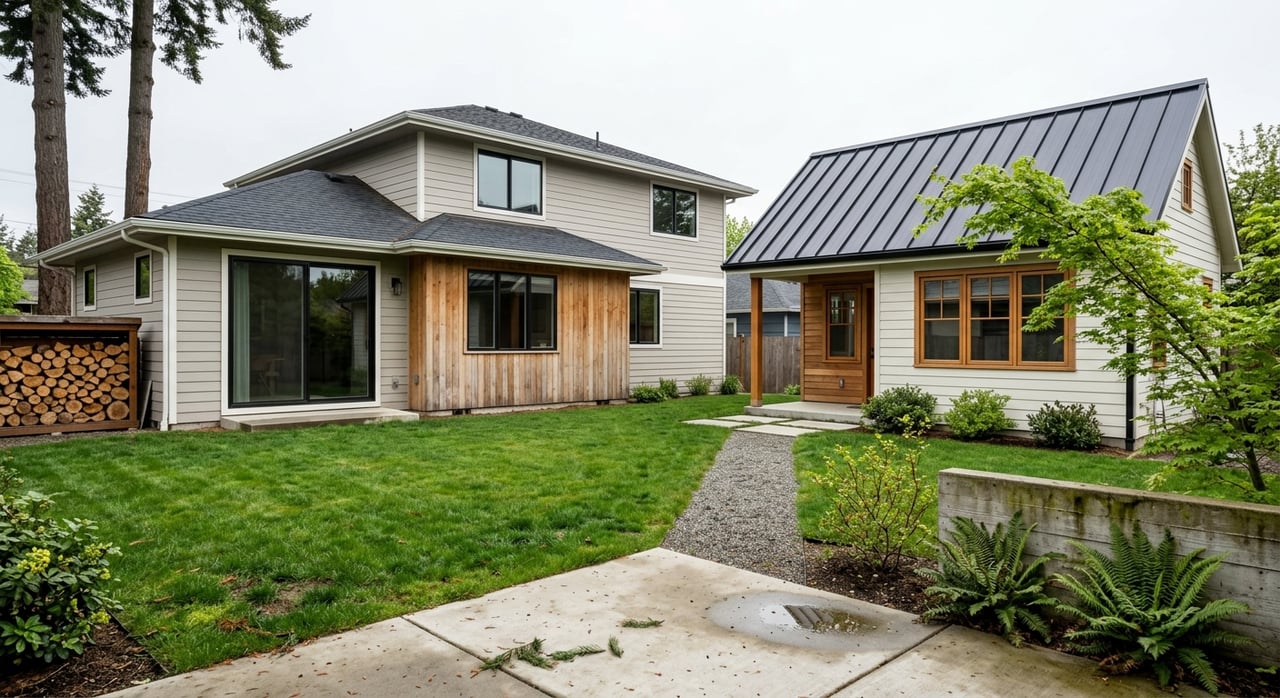
Every single-family lot in Bellevue can now carry up to two accessory dwelling units, attached or detached, capped at 1,200 square feet each, with no off-street parking required if the unit sits within a half mile of a major transit stop.
Before this ordinance, Bellevue only allowed attached ADUs. Detached units, the kind you'd actually build in a backyard, weren't permitted at all. Now a homeowner can add two units, and if that lot happens to sit inside a half-mile walk shed of a light rail station or a frequent bus stop, the parking requirement that would otherwise eat into the buildable footprint disappears entirely. The city has also started developing a pre-approved plans program that will let owners buy city-reviewed building plans instead of commissioning custom drawings, which is the kind of detail that shortens a permitting timeline more than any marketing copy ever will.
This is where the "median price by neighborhood" framing falls apart completely. A house in Bridle Trails and a house in Lake Hills can carry an identical ordinance-granted right to build two ADUs, but the ordinance doesn't grade lots on tree cover or covenant restrictions. Bridle Trails sits on large, heavily wooded parcels adjacent to Bridle Trails State Park, a 482-acre equestrian park with 28 miles of trails, and many of those lots carry HOA covenants that predate the state mandate and still have to be checked before anyone assumes a DADU is actually buildable there. A flatter legacy lot in Lake Hills or Crossroads, with fewer tree-canopy and covenant constraints, can turn the same zoning right into an actual permit far faster.
The most interesting parcels in Bellevue right now are the ones sitting at the intersection of both events: a single-family lot that also happens to fall inside a half-mile walk shed of one of the stations anchoring the city, from South Bellevue up through Spring District/130th. That combination removes the parking requirement on a second unit and sits inside a transit corridor whose usefulness just expanded with the March 2026 Seattle connection. Wilburton is a plausible example, a station open since 2024 surrounded by a mix of older residential streets and newer mixed-use blocks still filling in. It gets harder in Somerset, where the hillside lots that give the neighborhood its views also make a level building pad expensive to create, and harder still in Bridle Trails, where large wooded parcels often carry HOA covenants that predate the 2025 ordinance and still have to be cleared before anyone builds.
None of this shows up in a citywide median. It shows up when you ask two specific questions about a specific parcel, not when you compare one neighborhood's average sale price to another's.
Does the light rail premium already show up in Bellevue home prices? Only for the stations that were already destinations before the train arrived, Bellevue Downtown chief among them. Stations that gained their real utility on March 28, 2026, are still being priced by a market that's had less than half a year to react.
Can any homeowner in Bellevue build two ADUs right now? The zoning right exists citywide under Ordinance 6851, but private covenants, lot slope, and standard height and setback rules still apply on a parcel by parcel basis.
Do I still need parking for a Bellevue ADU? Not if the unit is under 1,000 square feet, or if it sits within a half mile of a major transit stop, per the city's land use code.
If you're weighing a purchase in Wilburton against one in Somerset, or trying to figure out whether a Lake Hills lot is worth more for its house or for what you could build behind it, that's not a spreadsheet question anymore. It's a walk-shed and covenant question, and it's exactly the kind of parcel-level read that a generic median can't give you.
Foundation First Group works both sides of this, resale and development, across Kirkland, Bellevue, and Redmond. If you're trying to figure out what a specific Bellevue lot is actually worth under the new rules, or which station's walk shed is worth paying for today, schedule a strategy session with a principal before you make an offer based on a number a portal generated last month.
Stay up to date on the latest real estate trends.
Foundation First Group's expertise includes assisting buyers and sellers of all property types, including single-family homes, condominiums, vacant land, and investment properties.